Guide
What each page shows and how to read it.
Protein page
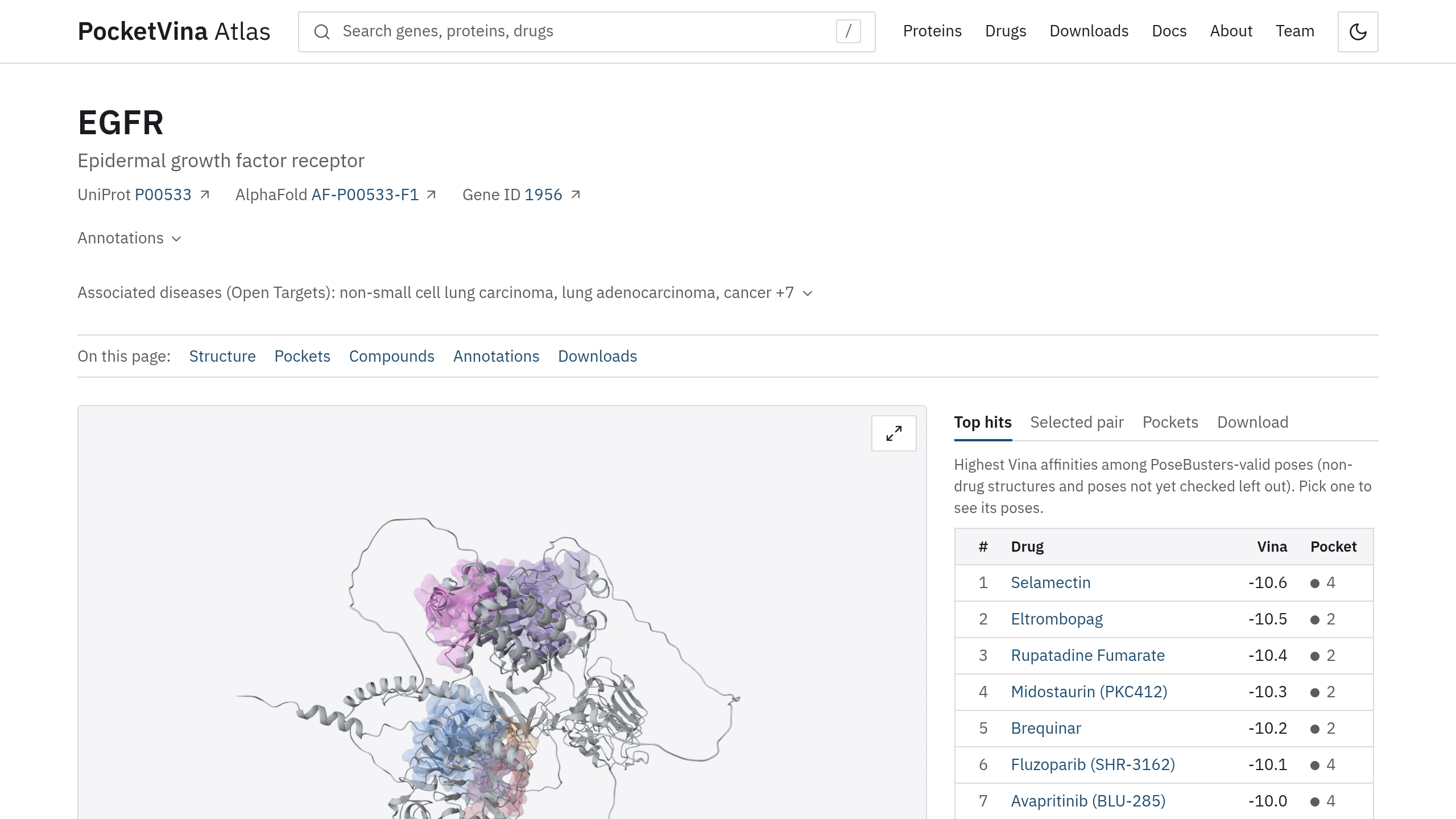
Open a protein from the search box (gene, UniProt or Ensembl ID). The page starts with the 3D structure: the AlphaFold model and its docked P2Rank pockets in colour. Next to it, Top hits lists the compounds with the highest affinity whose highest-affinity pose passed PoseBusters. Below are the Compounds table (every docked compound, sortable and filterable) and the protein's Downloads. Annotations (class, family, synonyms, links) open under the title.
A pair: one compound on one protein
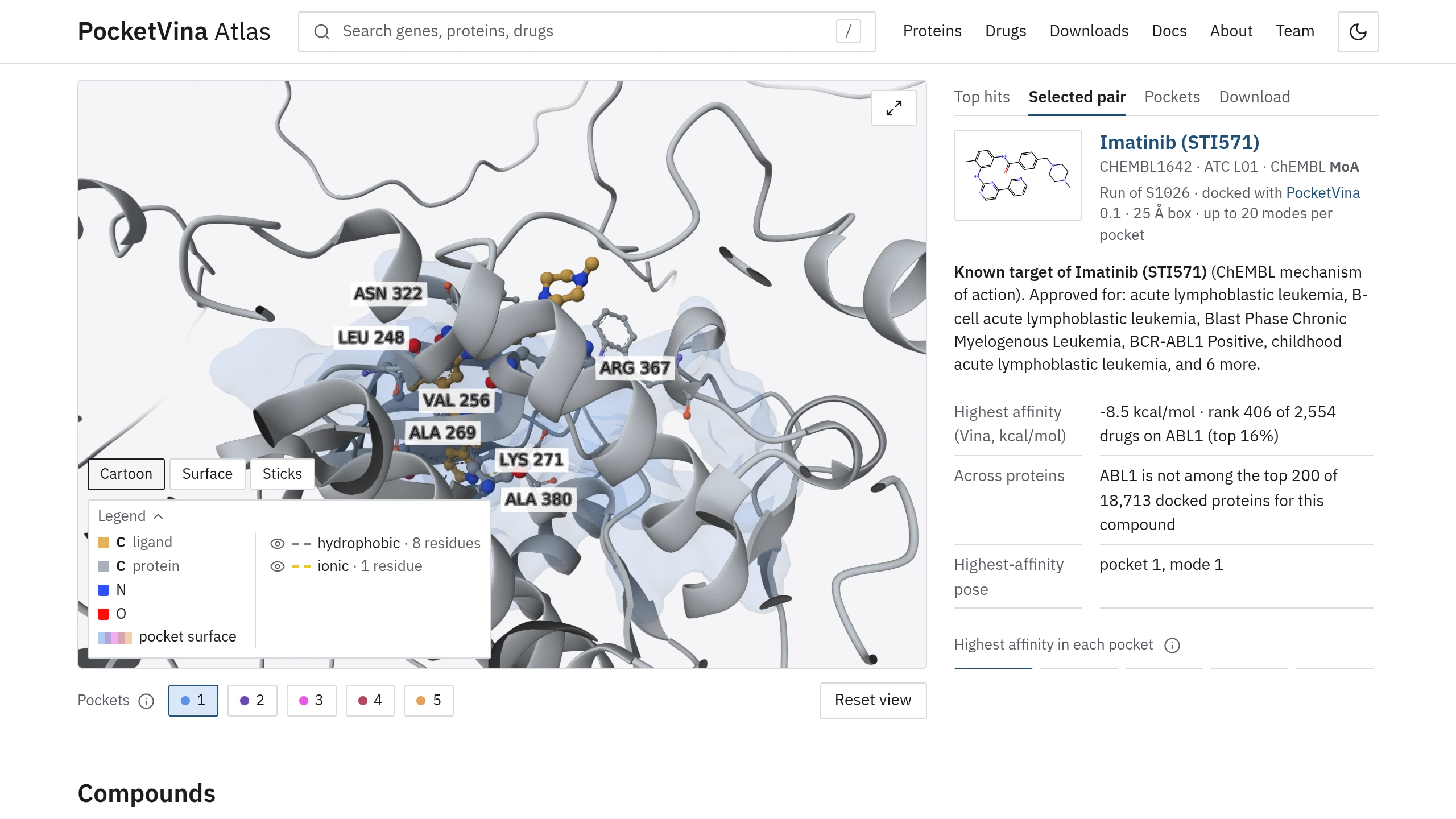
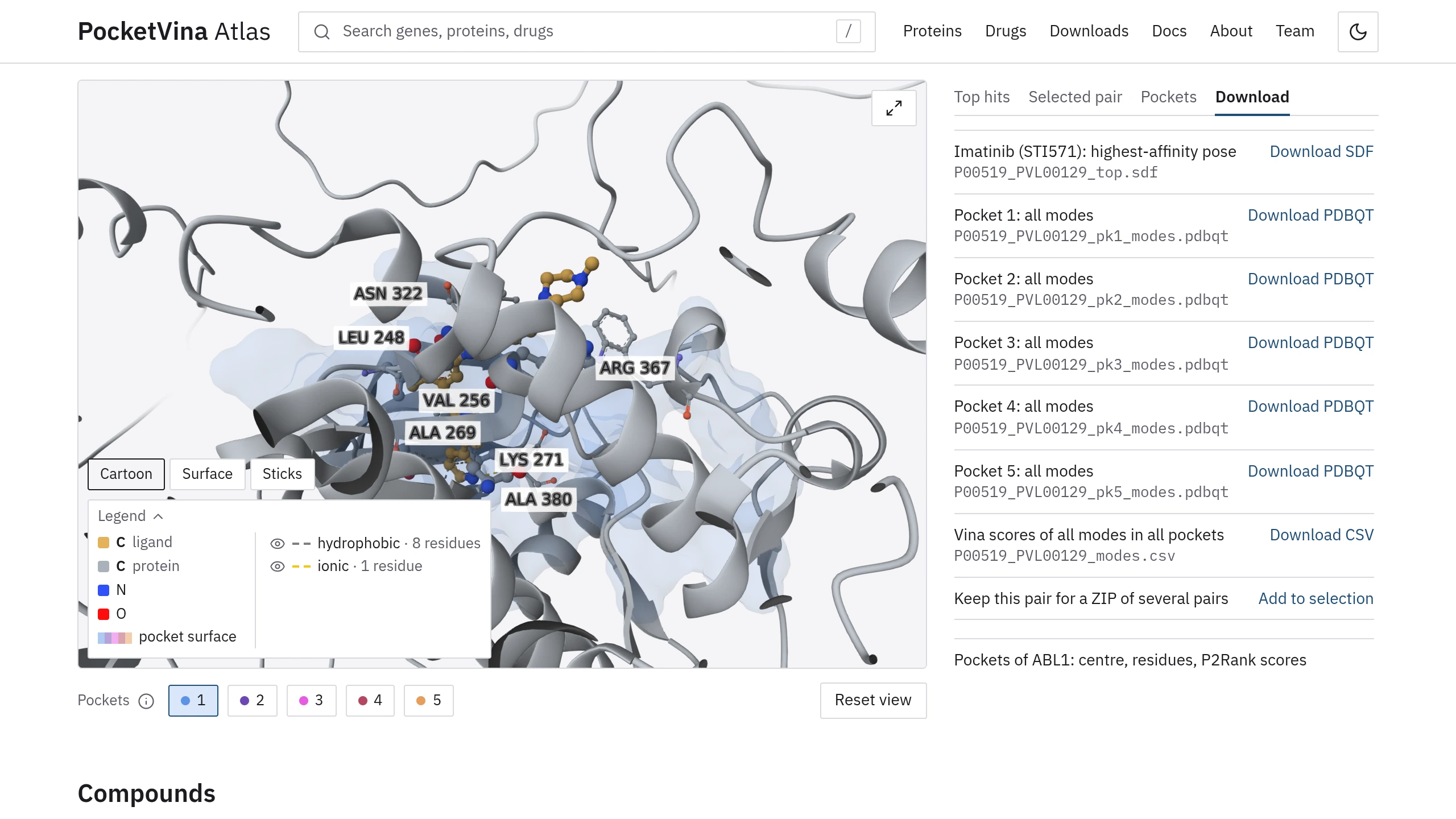
Pick a compound in Top hits or in the table. Selected pair shows the drug, its highest affinity (the lowest Vina score) with two ranks (among all compounds on this protein, and among all proteins for this drug), its highest affinity in each pocket (the filled button is the pocket shown in 3D, ★ marks the pocket with the highest-affinity pose; a click shows that pocket's poses), a mode stepper, the PoseBusters result (on the highest-affinity pose only, the one it checked) and the residues the pose touches. In 3D the ligand is coloured by element (gold carbon), the residues near it are thin sticks with grey carbon, the residues with an interaction are labelled, and dashed lines mark the non-covalent interactions between ligand and protein that Mol* finds. The legend in the corner names the carbons (C ligand, C protein) and the other elements of this pose, and for each interaction type the number of residues involved, the same as in the Contacts list; each type can be hidden. The button at the top right of the viewer opens it full screen. Example: imatinib on ABL1.
Pockets
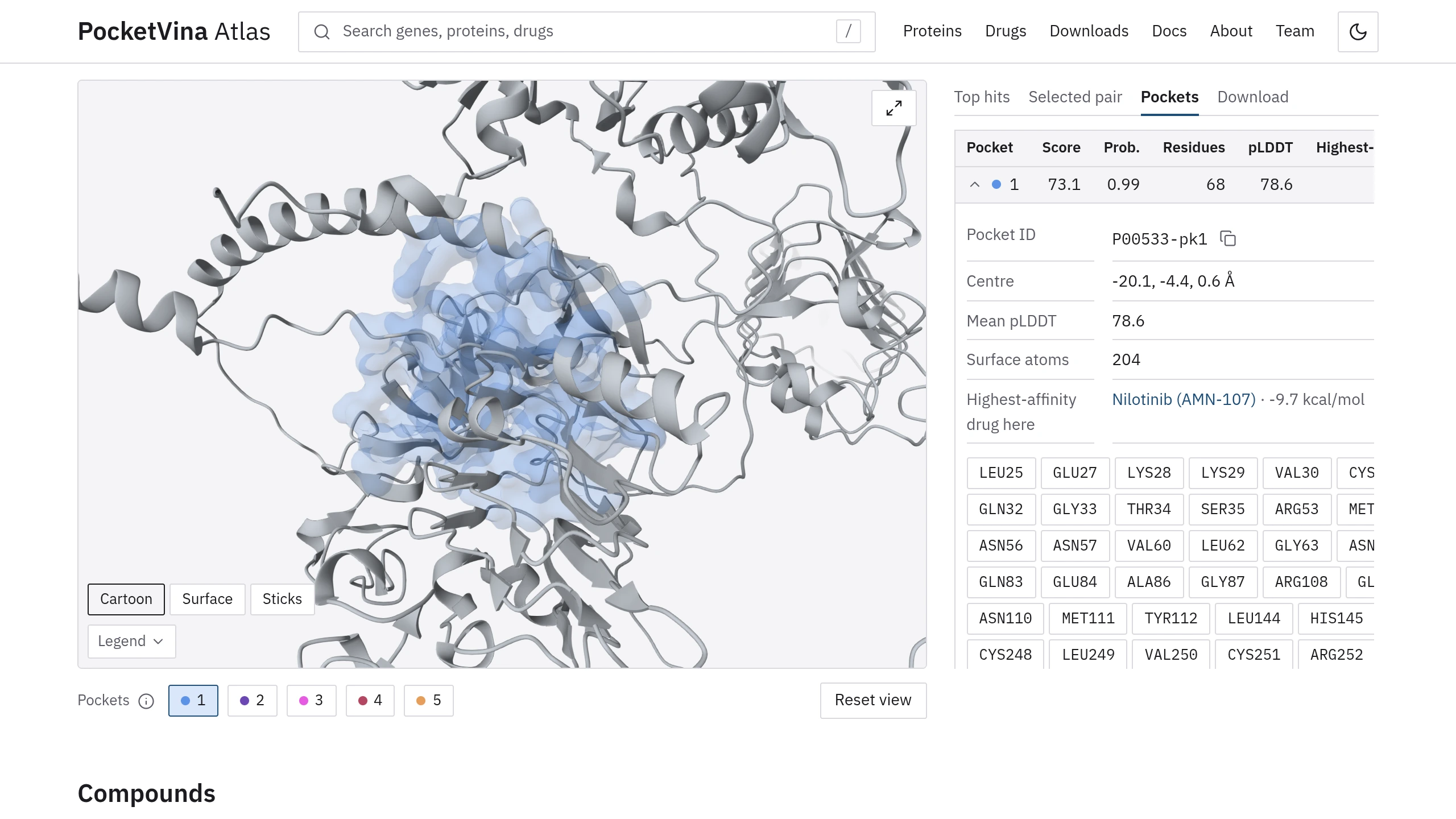
Each protein was docked in its top 5 P2Rank pockets, separately. The Pockets tab lists them with the P2Rank score and probability, the number of residues, the AlphaFold confidence (pLDDT) and how many compounds have their highest-affinity pose there. Open a pocket to see its residues, centre and highest-affinity drug; a residue opens in 3D.
Drug page
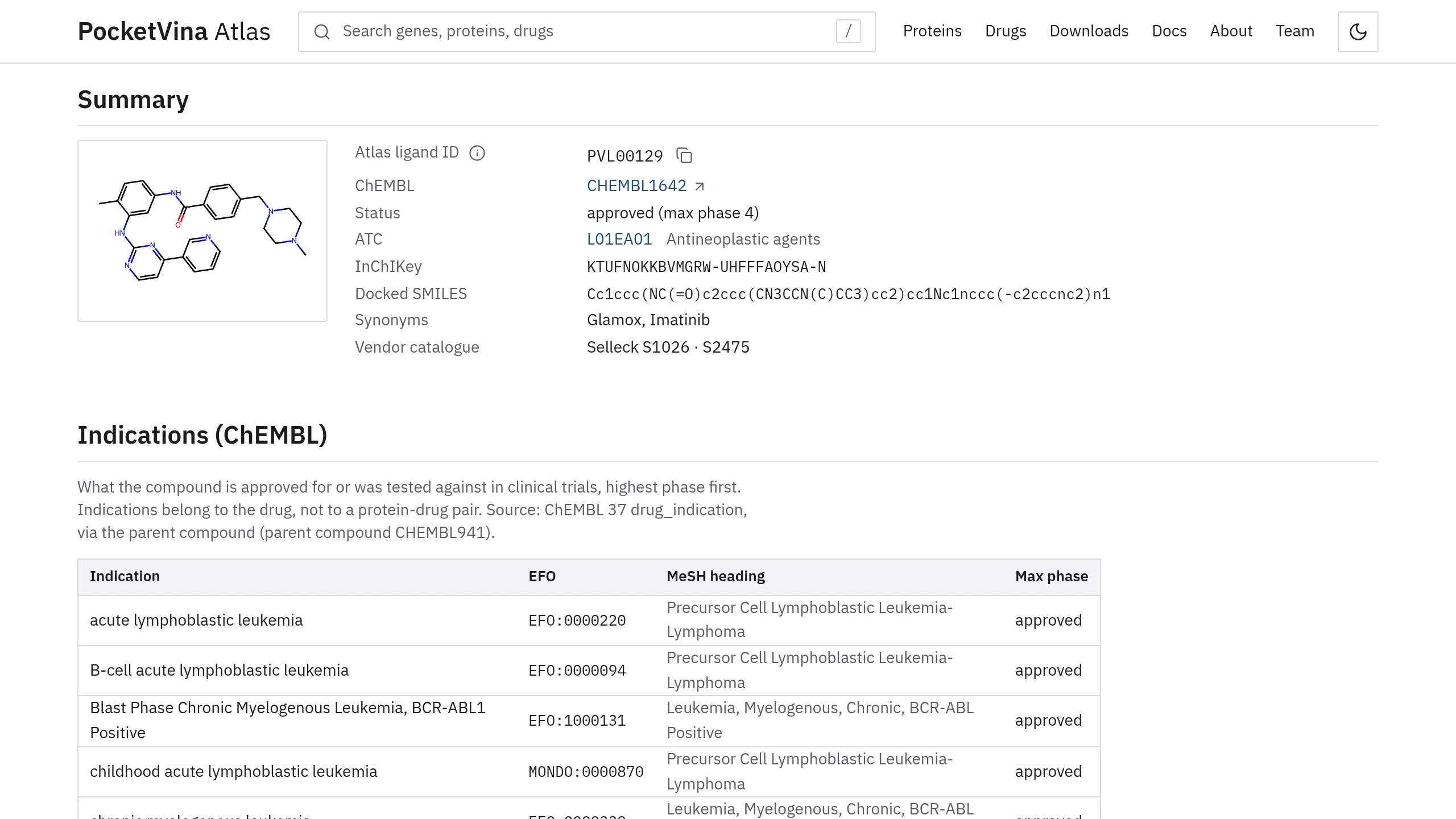
A drug page shows one docked structure, under its atlas ligand ID: identifiers (ChEMBL, InChIKey, SMILES), every vendor catalogue number docked as it, the ATC class, indications from ChEMBL, and every protein it was docked against, highest affinity first. A catalogue number, a ChEMBL ID or a name opens the same page. A salt and its desalted form are listed together and link to each other.
Reading the scores
- Vina scores are docking scores in kcal/mol, not measured affinities. More negative is better.
- Highest affinity means the lowest Vina score, the strongest predicted binding. It does not say that the pose is correct; the atlas has no other score, so "best" in file names means the same.
- Large ligands score better almost everywhere: compare a drug with other drugs on the same protein (rank), and a protein with other proteins for the same drug.
- PoseBusters checked the highest-affinity pose of each pair only (21 checks). A timeout or an error means not checked, not failed.
- A faint score with a plus sign means no favourable pose: no score in that pocket is below zero.
- No ChEMBL evidence does not mean no binding; most pairs were never tested.
Downloads
Three ways to take the data: single files on every protein page (the Download tab for the selected pair, and the Downloads section for the whole protein); your selection of pairs as a ZIP, a CSV or a download script (tick pairs in any table); and the bulk release on the Downloads page. Files are named after the identifiers: the UniProt accession for a protein (P00533_top.sdf.gz), the pair for a pair (P00519_PVL00129_top.sdf); the API page explains them. How to read the pose files and view a pose in PyMOL, ChimeraX or Jupyter: Download and visualise.
FAQ
- Is a good score a binder?
- No. A docking score ranks poses; use it to choose what to test, together with the pose, the PoseBusters result and ChEMBL evidence.
- What does "salt counterion" next to a compound mean?
- The library entry is a salt, and as screened its counter-ion (or a solvent, or one component of a product) was docked instead of the drug. The row keeps its scores and poses with that label. Where the atlas has the desalted form of the salt (
<catalogue number>-desalted), the drug's page lists both forms and links them. See About · Salts. - Which structure was docked?
- The AlphaFold DB model of each protein, unchanged; its file keeps AlphaFold's name.
- How do I cite the atlas?
- See Cite: PocketVina first, then the atlas and the tools it uses.
- Can I use the data?
- The licence has not been decided yet; see Downloads.